

I’ll be honest — I almost got scammed last week. Me. The person who’s been writing scam tips for over a decade. Shortly after covering a scam targeting authors, a slicker, more convincing version of the Podcast Pitch Scam landed in my inbox, and I nearly took the bait simply because I wasn’t paying close enough attention. If it can almost fool me, it can definitely fool you. Here’s what happened, what was different about this version, and — most importantly — how to spot it before it’s too late.
Mistake #1: Not paying attention
For years, I received book review requests from major publishers. When I finally decided to stop, I crafted a polished “thanks, but no thanks” reply and used it whenever a new request came in. Over time, those requests slowed to a trickle — so when one landed in my inbox a few weeks ago, I did what I’d done dozens of times before. I skimmed it, hit reply, pasted in my standard response, and moved on without a second thought. Clean, efficient, done.
Except it wasn’t a book review request.
Mistake #2: Walking Right Into The Podcast Pitch Scam
The next day, I got a reply. Odd, I thought — until I actually read it. Turns out the original email hadn’t been a book review request at all. It was from a “marketing professional” who helps authors land podcast and radio interviews. His response was friendly, patient, and completely reasonable:
“No worries at all, and just to clear up the mix-up: I wasn’t asking you to review a book, I help authors get podcast and radio interviews for their own books, so this wasn’t a review request on my end.”
Perfectly polite. Totally plausible. And I still didn’t catch on. I fired back a friendly reply, thinking I was simply smoothing over an awkward misunderstanding and closing the conversation. What I didn’t realize was that by responding at all, I’d done exactly what he wanted. I’d confirmed I was a real person, showed I was willing to engage, and cracked the door open just wide enough for him to wedge his foot in.
He was not about to let me go.
Breaking Up Is Hard To Do
His ask was simple: “A 10-minute call, no pitch, no pressure.”
And there it was. If you’ve never encountered this tactic before, file it away, because it’s a classic. “No pitch, no pressure” is specifically designed to lower your defenses and make saying no feel unnecessarily rude. Ten minutes sounds harmless. What’s ten minutes, right? But that call was never going to be ten minutes, and it was never going to be pressure-free.
By this point, I felt like I’d been caught in a spider’s web — I could practically feel the silk around my ankles. I’d already made two mistakes, and I knew that taking that call would be mistake number three. I did some quick due diligence. Sure enough, my “marketing professional” had no solid credentials. At this point, I knew the truth. The longer I stayed in the conversation, the greater the chance I’d accidentally hand over personal information or get worn down into agreeing to something I didn’t want.
The only move was a clean break. I filed the email away (so I could use it for this scam tip) and moved on. Normally, I’d have trashed it, but my next opportunity was too good to pass up. It was time for a scam tip.
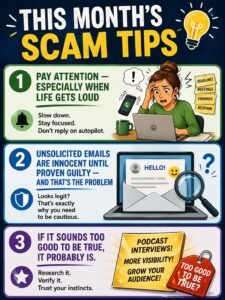
Tip #1: Pay Attention — Especially When Life Gets Loud
That one careless moment when I hit reply without actually reading the email taught me a lesson I already knew but had momentarily forgotten: never let your guard down. In my defense, I was dealing with a lot at the time — but here’s the uncomfortable truth. Stress and distraction are exactly when scammers are most likely to succeed. When life gets loud, that’s your cue to slow down, not speed up. If an email can wait five minutes for your full attention, let it wait.
Bottom line: Autopilot is a scammer’s best friend.
Tip #2: Unsolicited Emails Are Innocent Until Proven Guilty — And That’s the Problem
There was absolutely nothing suspicious about these emails. No broken English, no outrageous claims, no requests for bank details. Just a friendly, professional note that blended seamlessly into my inbox. The only red flag was the one I missed entirely: I had no idea who this person was or why they were contacting me. An unsolicited email that looks completely legitimate is often more dangerous than an obvious scam, because it doesn’t trigger your internal alarm bells.
Bottom line: If you didn’t ask for it, scrutinize it.
Tip #3: If It Sounds Too Good To Be True, It Probably Is
Once this “marketing professional” pivoted to his sales pitch, the bait was genuinely tempting — podcast interviews, radio spots, increased visibility for my book. What author wouldn’t want that? These scammers are very, very good at identifying exactly what you want to hear and packaging it in a way that feels credible. Before you hand over a single dollar — or a single piece of personal information — research the person independently, ask for verifiable references, and trust your instincts if something feels even slightly off.
Bottom line: Legitimate opportunities don’t need to chase you down through cold emails.
And that’s a wrap on this month’s scam tip! The good news? I escaped with my wallet and my dignity mostly intact — and now you’re armed with the same knowledge that took me an awkward email exchange to learn. Have you encountered something similar to the Podcast Pitch Scam? I’d love to hear about it in the comments below. Stay sharp, stay skeptical, and I’ll see you next time!
Click here to see all my Scam Tips. If you missed last month’s scam tip, you can use this link to view The Fake Podcast Interview Invitation. And, if you’ve been scammed, report it at ReportFraud.gov


I got a pitch from an alleged Goodreads group leader to “nominate” my book for a discussion within her group. There is a group by that name, and the moderator has the same name as my inquirer, but I was suspicious by the AI sounding praise and her odd gmail address. She said there would be no fees involved, and we could set a date and time for the discussion. All she’d need would be my book cover and blurb. I almost followed through but decided I couldn’t take a chance, because while tempted to participate, this smelled like a scam. I declined the offer.
Sounds fishy to me,too, Nancy!