
I write scam tips for everyone — but this one’s personal. Recently, I’ve landed in the crosshairs of scammers who specifically target writers like me, and I’ve received three suspicious emails to prove it. The scam is called “The Fake Podcast Interview Invitation,” and trust me, it’s as flattering as it is dangerous. If you’re a writer with any kind of public profile, you’ll want to read this.
How the Fake Podcast Interview Scam Works
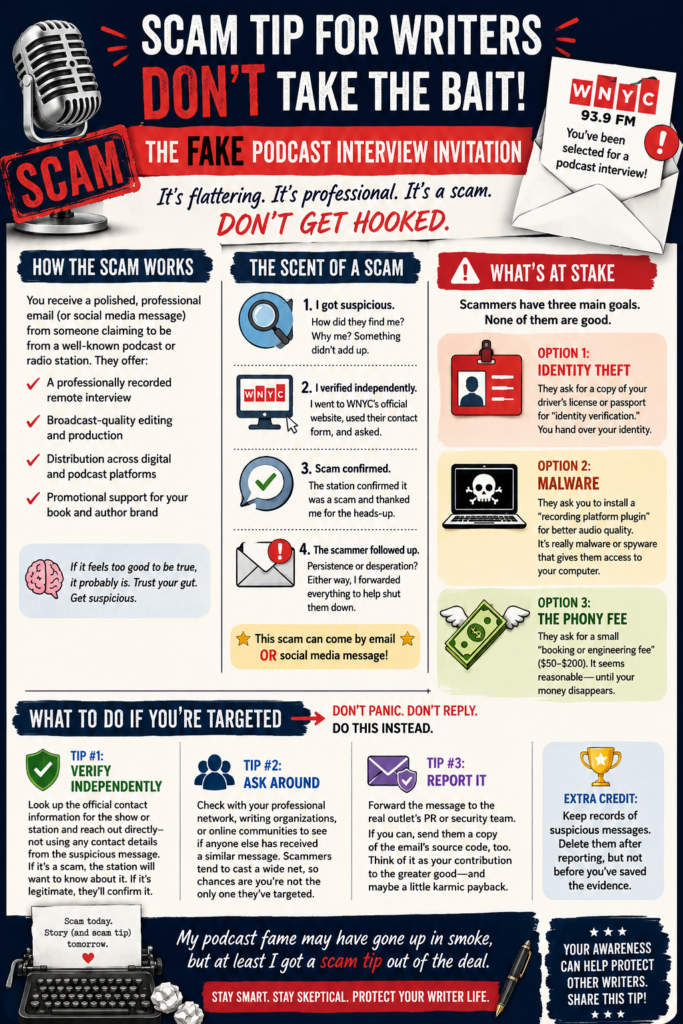
In my case, the email came from someone claiming to be Alison Stewart from WNYC 93.9 FM — a real, well-known radio station. The message was polished and professional, offering everything a writer could dream of: a professionally recorded remote interview, broadcast-quality editing and production, distribution across digital and podcast platforms, and promotional support for my work and author brand. I mean, come on. If you’d dangled that in front of me on a street corner, I probably would have followed you into a dark alley.
And then my brain kicked in. How did she find me? And why me, of all people? Something didn’t add up. The flattery was a little too perfect, the offer a little too generous. So instead of hitting reply, I did what any self-respecting scam tip writer would do — I got suspicious.
The Scent of a Scam
The next day, I went to WNYC’s official website — not the link in the email, mind you — found their contact form, and fired off a message. A couple of days later, I had my answer: yep, it was a scam. The station was grateful for the heads-up, and I was happy to send them a copy of the email’s source code to help with their investigation. Consider it my civic duty.
Then, almost as if on cue, “Alison Stewart” sent me a follow-up. I had to admire this guy’s persistence, but that didn’t stop me from wanting to see him shut down. Whether the station succeeded or not, the scammer had picked the wrong writer to mess with. Oh, and one more thing worth mentioning: this scam doesn’t always arrive by email. Sometimes it shows up in your social media messages, wearing the same professional disguise and carrying the same too-good-to-be-true offer.
What’s at Stake
The fake podcast interview invitation scam isn’t just about crushing the dreams of starry-eyed writers. It’s about cold, hard exploitation. Once you’re hooked, the scammer has a few tricks up their sleeve, and none of them are good.
Option 1: Identity Theft. They ask for a copy of your driver’s license or passport for “identity verification.” It sounds reasonable — until you realize you’ve just handed a criminal the keys to your life.
Option 2: Malware. They ask you to install a “recording platform plugin” to ensure the best possible audio quality. Spoiler alert: the only thing it’s recording is everything on your computer. The plugin is actually malware or spyware that gives the scammer remote access to your machine.
Option 3: The Phony Fee. They ask for a small “booking or engineering fee” — somewhere in the range of $50 to $200. It seems reasonable for a professional production, right? Wrong. That money goes straight into a scammer’s wallet, never to be seen again.
What to Do If You’re Targeted
If one of these emails or messages lands in your inbox, don’t panic — and whatever you do, don’t reply. Here’s what to do instead.
Tip #1: Verify independently. Look up the official contact information for the show or station and reach out directly — not using any contact details from the suspicious message. If it’s a scam, the station will want to know about it. If it’s legitimate, they’ll confirm it.
Tip #2: Ask around. Check with your professional network, writing organizations, or online communities to see if anyone else has received a similar message. Scammers tend to cast a wide net, so chances are you’re not the only one they’ve targeted.
Tip #3: Report it. Forward the message to the real outlet’s PR or security team. If you can, send them a copy of the email’s source code, too. Think of it as your contribution to the greater good — and maybe a little karmic payback. (You can also report scams at IC3.gov.)
As for me, my dreams of podcast fame and a nationally broadcast author interview may have gone up in smoke — but at least I got a scam tip out of the deal. Not exactly the exposure I was hoping for, but I’ll take it.
I’d love to hear your thoughts on this month’s scam tip. Please leave a comment below, and thanks for being here!
See all my Scam Tips here. If you missed last month’s post, you can use this link to view Summer is Coming, and So are the Travel Scams.


Thanks for the great tips, Terry. I’ve been reading about these scams for a while now on the Authors Guild website. It always makes me feel a little sad to know these scammers are out there.
Thanks for the comment, Theresa. It is sad, and the scams are getting better and better. Be wary of anything that comes at you out of the blue!
Nobody of any significance cold calls. Don’t even read them anymore; if my email program hasn’t already put them in junk (which it’s become very good at), I do. I don’t bother blocking because odds are, they’re using different emails.