

Who knew being broke and caffeinated would make us such attractive targets? Yet here I am, writing my third scam alert aimed at writers in as many months. Apparently, scammers have discovered that while we may not have money, we do have righteous indignation—and that’s almost as good. This month’s scam exploits everyone’s favorite rage-inducing topic: the Anthropic class action lawsuit.
Background on the Anthropic Lawsuit:
Remember when Anthropic (and OpenAI, because misery loves company) decided to treat the entire internet like an all-you-can-eat buffet? They scraped countless authors’ works to train their AI models, paid exactly $0.00 for the privilege, and acted shocked when writers got litigious about it. Cue the inevitable lawsuits for copyright infringement.
Now, scammers—who apparently monitor the writing community’s collective blood pressure—have spotted an opportunity. They’ve realized that angry writers are motivated writers, and motivated people click on things. So they’ve crafted a new scheme to harvest money and personal information from the very people already furious about being exploited.
It’s scams all the way down, folks.
What’s in it for the bad guys?
The bad guys want what they always want, but this time, there’s a literary twist. The goals may change from one “offer” to the next, but they all fall into the same categories.
- Harvest personal information from authors and journalists (because our data is apparently worth more than our royalties)
- Solicit fake “claim fees” or “settlement processing fees” (the irony of paying money to receive money is not lost on us)
- Deliver malicious links or attachments disguised as legal documents (nothing says “legitimate” like a file named “URGENT_SETTLEMENT_FINAL_v3.exe”)
- Phish for login credentials to email, banking, or other accounts
How the scam works
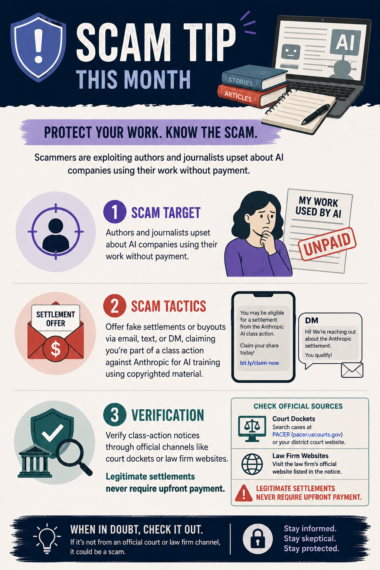
Whether we’re talking email, text, or DM, the scam always begins the same way, with all paths leading to identity theft:
Step 1: The Irresistible Offer
The offer slides into your email, LinkedIn direct messages, or social media messages like a literary agent who’s actually read your manuscript. Scammers dangle a buyout of your claim—cold, hard cash now instead of waiting for the glacial pace of actual legal proceedings.
Step 2: The Legitimacy Theater
It arrives from a “legal representative” or “settlement manager” complete with official-sounding credentials. They claim to work for a real law firm, or they’ve created a convincing knockoff website (think “anthropic-legal.com” or some derivation designed to tempt you).
Step 3: The Hook
They explain you’re part of a “class action against Anthropic for AI training using copyrighted material.” This part is actually true. What’s not true is that you’re automatically included—many writers never joined the lawsuit.
Step 4: The Trap
To “process your claim,” you’ll need to confirm your information or provide a government ID or tax documents. And congratulations—you’ve just handed scammers everything they need to ruin your credit score. It’s classic Identity Theft 101.
How to avoid the scam
Look, if you’re determined not to wait for the official proceedings to end, I get it. Patience isn’t everyone’s virtue, and the promise of immediate compensation is tempting. But if you want to protect yourself while pursuing a claim, you’ll need to verify that any request is legitimate—and that means checking directly with official sources, not relying on information provided in the message you received.
The safest option is, of course, to wait for the final outcome. But if you just can’t resist the offer, here’s what you need to know:
Tip 1: Verify through official channels
Check any class-action notices against the official court docket or law firm websites. Real case details will always appear on verified platforms like CourtListener, PACER (fees apply), or the law firm’s official domain. Don’t trust what the message tells you—search for the law firm independently.
Tip 2: Treat unsolicited messages with suspicion
Never click links or download attachments from unsolicited emails, even if they appear to concern a class action or settlement. It doesn’t matter how legitimate they seem—verify first, click later.
Tip 3: Legitimate settlements never cost money
Do not pay anything or provide bank details to “claim settlement funds.” Real class actions distribute checks or wire transfers at no cost to claimants. If someone’s asking you to pay to get paid, that’s your red flag.
Tip 4: Scrutinize domain names
Law firms use .com or .law addresses directly linked to their public websites—not variations like “anthropic-legal-settlement.info” or similar. When in doubt, search the firm’s name plus “scam” or “alert.” Often, others have already reported fraudulent use of legitimate firm names.
Tip 5: If you’ve already responded, act immediately
- Change any passwords you may have provided
- Notify your bank if you shared financial information
- Run a full malware/antivirus scan on your device
- Report the incident to the FTC at ReportFraud.ftc.gov
That’s it for this month’s scam tip. I hope it helps you spot the red flags before the scammers get their hooks in. I’d love to hear your thoughts or questions—have you encountered anything suspicious lately? Please leave a comment below, and thanks for being here and looking out for each other!
Click here to see all my Scam Tips. If you missed last month’s post, you can use this link to view The Podcast Pitch Scam Targeting Authors Right Now.





Yes, I just started getting these. Fortunately I am habitually sluggish and happy to wait! But thanks for this which will help me counteract friends who are tempted.